Discovery
Understand the current system, the constraints and the outcome that defines success.
IT services & software development
KIO BARBER LTD designs, builds and maintains software systems: custom applications, web platforms, cloud infrastructure and the integrations that connect them. Careful engineering, documented decisions, measured delivery.

KIO BARBER LTD works with organisations that depend on software to operate. Every engagement begins with understanding the system that already exists — its data, its constraints and the people who rely on it.
The work spans the full lifecycle: shaping requirements into a technical plan, writing and reviewing the code, provisioning the infrastructure it runs on, and keeping it healthy after release. We favour readable implementations, explicit interfaces and changes small enough to reason about.
The company name contains “BARBER”, but the business is information technology: software engineering and the operational disciplines around it.
Six connected disciplines. Most engagements combine several of them rather than standing alone.
Off-the-shelf tools stop at the edge of a process. Custom development starts there: modelling the entities that matter, encoding the rules that govern them and exposing only the operations a user actually performs.
We write services in maintainable, well-supported stacks, keep business logic separate from transport concerns, and document the decisions that would otherwise be lost between releases. Schema changes are versioned and reversible.

A web application is judged on the fifth hour of use, not the first minute. We build for that: predictable navigation, honest loading and error states, keyboard access and layouts that survive small screens.
Server-rendered and prerendered pages so content and metadata are available on first load.
Explicit data fetching, caching rules and invalidation instead of implicit refresh cycles.
Semantic structure, focus management and contrast checked against WCAG guidance.
Responsive images, deferred non-critical work and budgets for page weight.

Infrastructure work covers how software is packaged, where it runs and how it is observed. We describe environments as configuration, keep development, staging and production aligned, and automate the path from commit to deployment.
Logging, metrics and alerting are part of the build rather than an afterthought, so failures surface with enough context to act on. Backup and restore procedures are written down and rehearsed.
Integration work begins with a map: which system owns each piece of data, how often it changes and what happens when a transfer fails. From there we build the connective layer — APIs, scheduled jobs, event handlers and transformations.
Typed, versioned interfaces between services so changes do not break silently.
Retries, idempotency and dead-letter handling for transfers that must not be lost.
Run histories and reconciliation checks that make data movement auditable.
Quality assurance is continuous rather than a phase at the end. Unit tests cover logic, integration tests cover boundaries, and end-to-end checks exercise the flows a user depends on. Exploratory testing catches what scripted checks cannot.
Isolated logic, edge cases and error paths.
Database, queue and third-party boundaries.
Critical user journeys in a real browser.
Regression and smoke checks before promotion.
Security is treated as an engineering property: least-privilege access, validated input, secrets kept out of source control and dependencies reviewed for known vulnerabilities.
Understand the current system, the constraints and the outcome that defines success.
Architecture, data model, interfaces and a sequence of increments with clear scope.
Short cycles, reviewed changes and a working system demonstrated throughout.
Automated tests, manual review and acceptance against the agreed scope.
Staged deployment, migration checks and a documented rollback path.
Monitoring, updates, small improvements and response when something breaks.
The implementation that the next engineer can read wins over the one that is shorter.
Proven, well-documented technology chosen over novelty, unless novelty solves a real constraint.
Work broken into increments that can be reviewed, released and reversed independently.
Architectural choices recorded with their trade-offs so they can be revisited deliberately.
Third-party services wrapped behind our own interfaces to limit the blast radius of change.
Performance work driven by profiling and real usage rather than assumption.
The scenarios below are illustrative examples written to show typical scope. They are not descriptions of completed client projects, and no client names or results are implied.
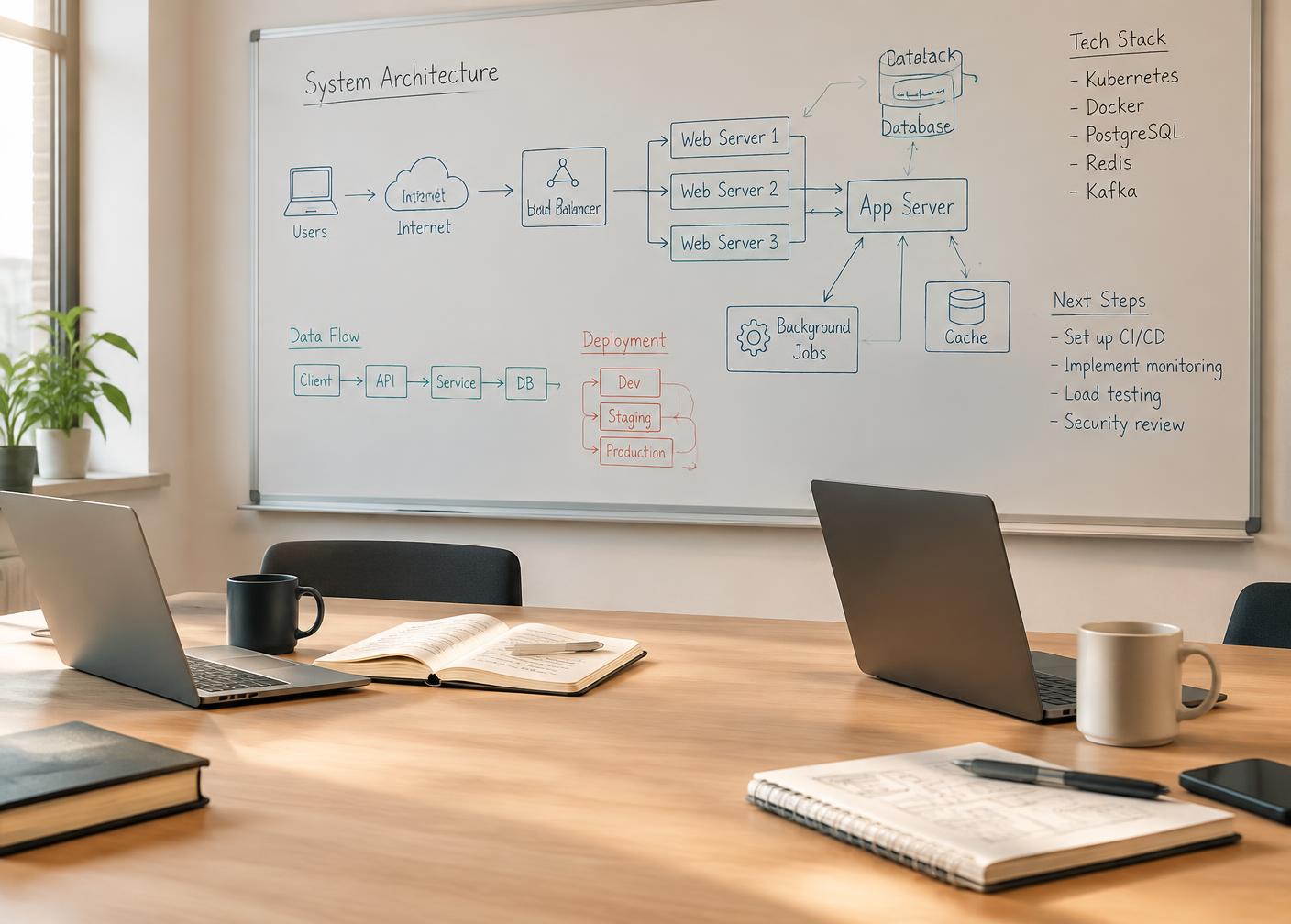
Projects run on written communication: a shared scope document, a visible task board and regular written updates on what changed, what is next and what is blocked. Meetings are used for decisions, not status.
Technical questions get technical answers, including when the honest answer is that an approach carries risk. Handover material — architecture notes, runbooks and environment documentation — is produced during the work, not after it.
Software engineering work: custom applications, web platforms, cloud infrastructure, integrations between systems, quality assurance and ongoing maintenance of software already in use.
No. KIO BARBER LTD is an IT company. The name is a company name only; all services relate to software development and IT.
With a discovery conversation about the current system and the outcome you need, followed by a written technical plan describing scope, sequence and assumptions.
Yes. Reviewing, extending and stabilising software that is already running is a regular part of the work, including systems with limited documentation.
Established, well-supported stacks chosen per project. The selection depends on the problem, the team that will maintain the result and the constraints of the existing environment.
Ongoing support is available: monitoring, dependency updates, incident response and incremental improvements agreed in advance.
Through written updates and a visible task board, with a working version of the system demonstrated as increments are completed.
By email at ingriddutton182@gmail.com. Describing the current situation, the outcome you are aiming for and any timing constraints helps us reply with something useful.
Enquiries are handled by email. The details below are shown as plain text.